

This is a cache of https://www.paroc.com/en/article/the-hidden-heat-loss-path-brackets-and-fasteners-in-ventilated-facades. It is a snapshot of the page as it appeared on 2026-05-31T00:06:13.794+0000.
| Paroc Article Skip to Main Content
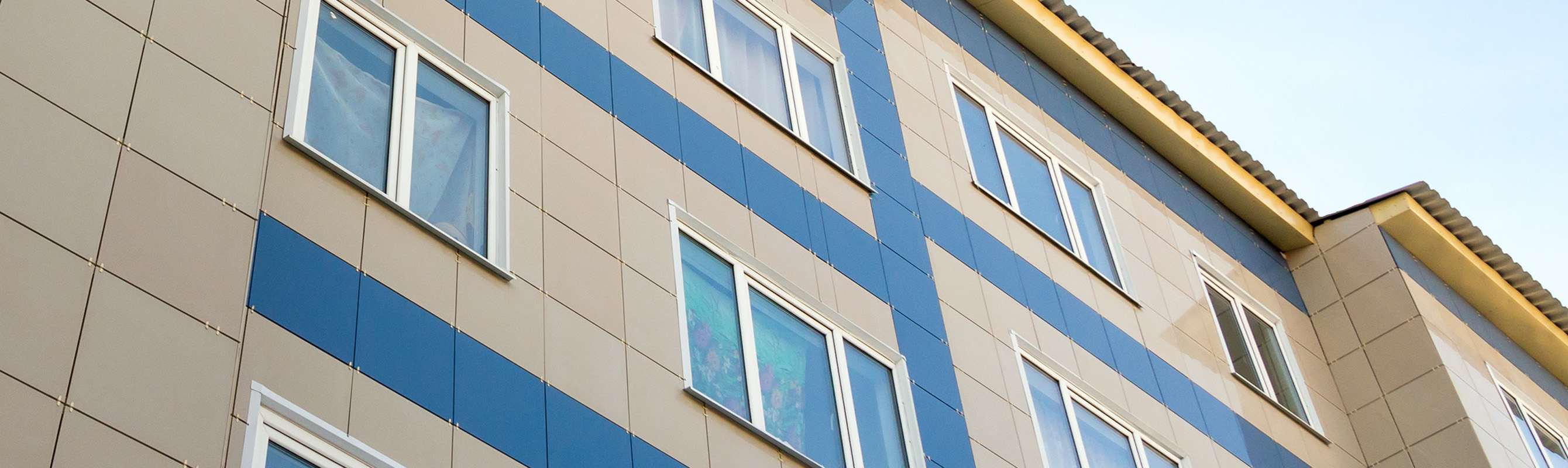
Ventilated facade with many windows

The Hidden Heat-Loss Path: Brackets and Fasteners in Ventilated Facades

Written By ParocDate Published 2026-05-27

In a ventilated facade, wall brackets and insulation fasteners are structurally essential—but they also penetrate the insulation layer and create thermal bridges. If their impact is ignored during design and construction, some of the expected improvement in energy efficiency is lost because metal conducts heat many times more effectively than insulation. In practice this shows up as additional heat loss, which must be accounted for by either increasing insulation thickness or selecting a bracket solution with better thermal performance. For this reason, wall brackets should be treated as part of the insulation system (not as stand-alone fixing components). The right bracket choice can reduce the required insulation thickness and save both energy and material.

In earlier articles, we covered (1) the design of the ventilation gap and (2) how airflow affects the thermal performance of the facade build-up. This article focuses on a factor that is frequently underestimated or even completely neglected in thermal calculations: wall brackets and fasteners that penetrate the insulation layer—and the thermal bridges they create.

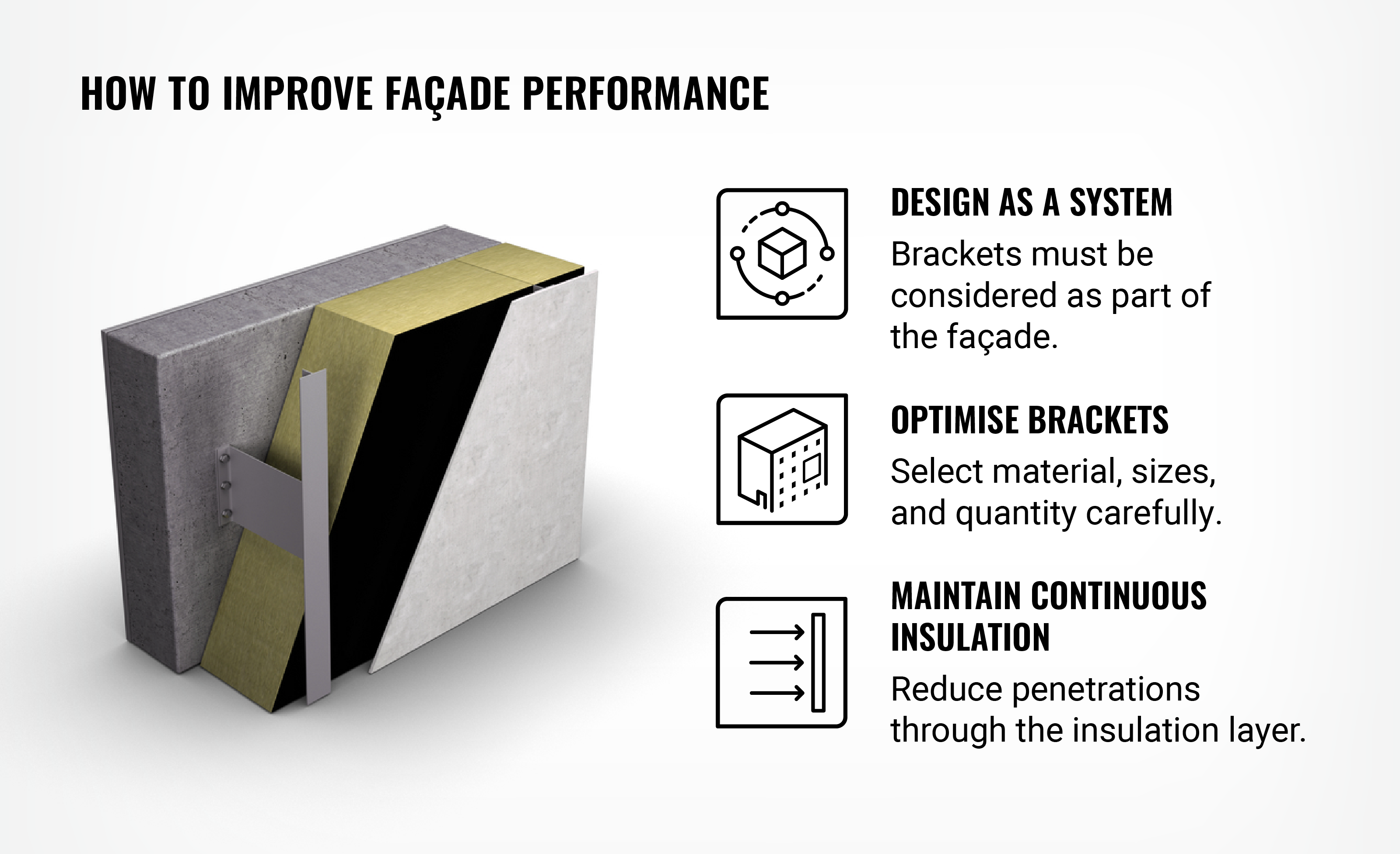
How to improve façade performance

A facade’s thermal performance is the result of the combination of the insulation, substructure, and quality of execution.

Why can brackets and fasteners dominate thermal performance?

In many projects, facade design starts with selecting the cladding and then choosing a substructure that transfers cladding loads into the load-bearing frame and insulation. In a ventilated facade, wall brackets carry the cladding and define the stand-off distance from the structure; the insulation and ventilation cavity occupy this space. Thermally, however, the layer is not uniform because a significant number of metal brackets and fasteners penetrate the insulation (depending on wind loads, energy efficiency targets, and cladding weight). Each part penetrating the insulation acts as a thermal bridge: a path that conducts heat faster than the surrounding insulated area. With hundreds of fasteners, the combined effect can significantly reduce real-world thermal performance.

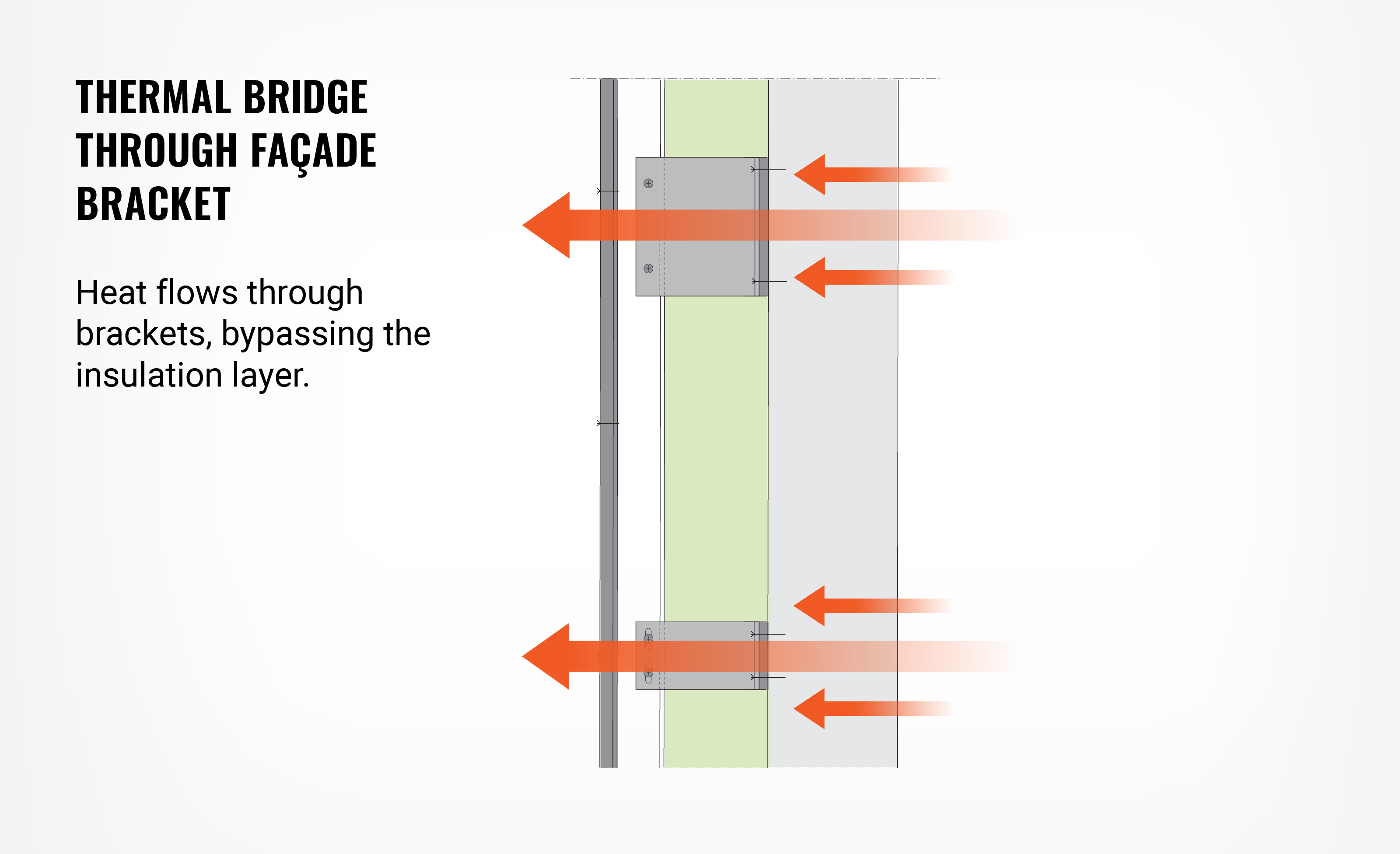
Heat flow in a ventilated facade system

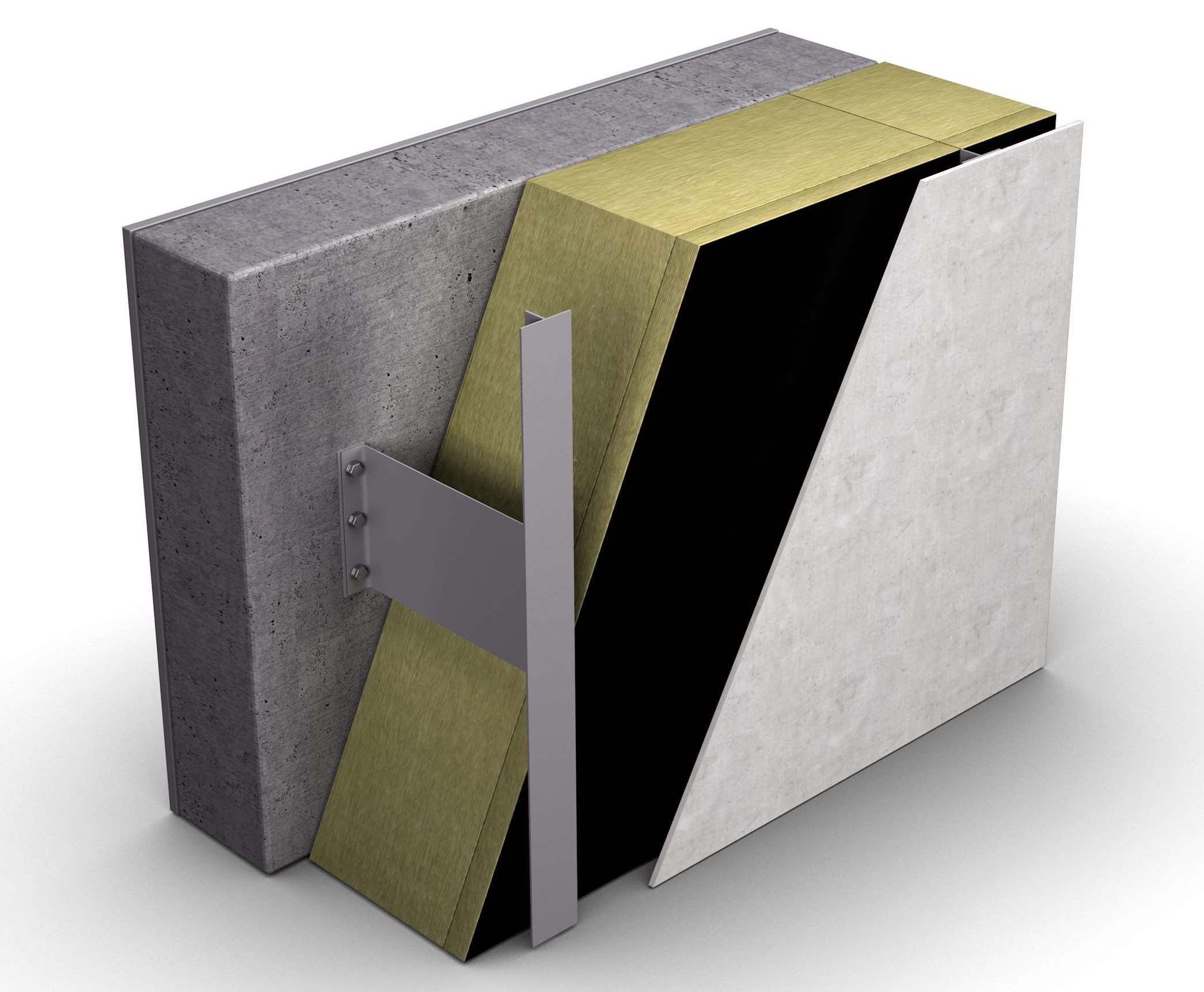
Insulation is intended to slow down heat transfer through the wall. Metal wall brackets create direct, highly conductive paths enabling heat to pass through the insulation layer. This increases total heat loss through the wall and can materially reduce energy performance.

“If you want to assess the energy efficiency of a ventilated facade, you will have to pay special attention to wall brackets and fasteners that penetrate the insulation layer. Metallic elements in particular conduct heat extremely well and can significantly reduce energy performance,” notes Alex Lalla, Application Manager, Building Insulation at OC Paroc. 

A facade’s thermal performance is the result of the combination of the insulation, substructure, and quality of execution. Wall brackets are the instrumental part of this combination: they are structurally necessary, yet they largely determine how much the insulation layer is weakened by thermal bridging.

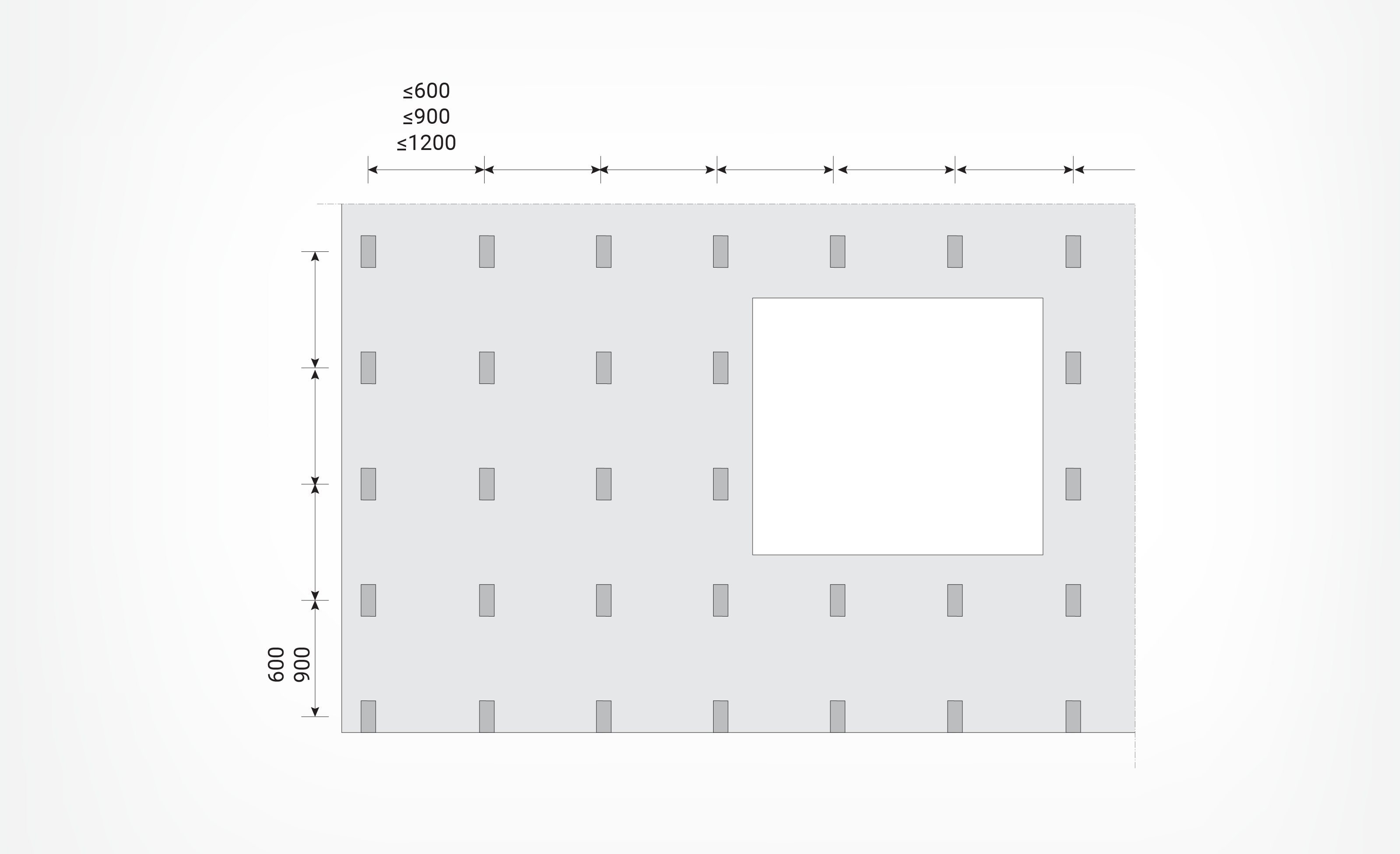
Photo of Alex Lalla, Application Manager, Building Insulation

Alex Lalla, Application Manager, Building Insulation

How do wall brackets increase heat loss in practice?

The impact of wall brackets is most clearly seen as additional heat loss. Instead of heat flowing only through the insulated area (as simplified calculations may assume), some of the heat is conducted through the metal brackets and fasteners. These create “short-circuit” paths through the insulation layer, increasing overall heat transfer. This is not an exception—it is inherent in how ventilated facades are fixed to the load-bearing structure.

A single bracket may seem insignificant, but real facades typically contain hundreds of fasteners with varying sizes. The effect is cumulative: point thermal bridges form a network that can reduce the energy performance of a whole building and explain part of the gap between calculated (idealized) and expected performance.

Typical bracket layout and spacing in a ventilated facade system

Brackets are installed across the facade at regular intervals, often several per square meter. Each fixing point is a thermal bridge; together they create a network of heat-loss paths through the insulation layer.

The magnitude of thermal bridging depends on the fasteners’ material (thermal conductivity), geometry (cross-sectional area, length, contact area), and quantity and spacing. Losses can be compensated for by adding insulation thickness, but this increases the cost and may also increase the bracket length and load bearing capacity requirements. A more efficient strategy is to reduce the thermal bridge in the fixing system itself—for example, by using a thermal break or a less conductive material.

Since thermal conductivity differs greatly between materials, the same facade build-up can perform very differently depending on whether the brackets are made from, for example, aluminum or stainless steel, or whether a solution with thermal breaks is used. The more fasteners a facade requires, the more critical material choice becomes.

When the calculated U-value meets real-world execution

The U-value (W/m²K) describes the thermal transmittance of a building element: how much heat flows through the structure per unit area and per K (degree of C) of temperature difference. The lower the U-value, the better the insulation performance and the lower the heat loss.

U-values are often calculated assuming a continuous, homogeneous insulation layer. In ventilated facades, wall brackets and fasteners penetrate the insulation and introduce point thermal bridges. Their impact must be included as an additional correction, ΔU (increase in thermal transmittance). In practice, ΔU increases the facade’s “effective” U-value compared to a value based on insulation thickness alone.

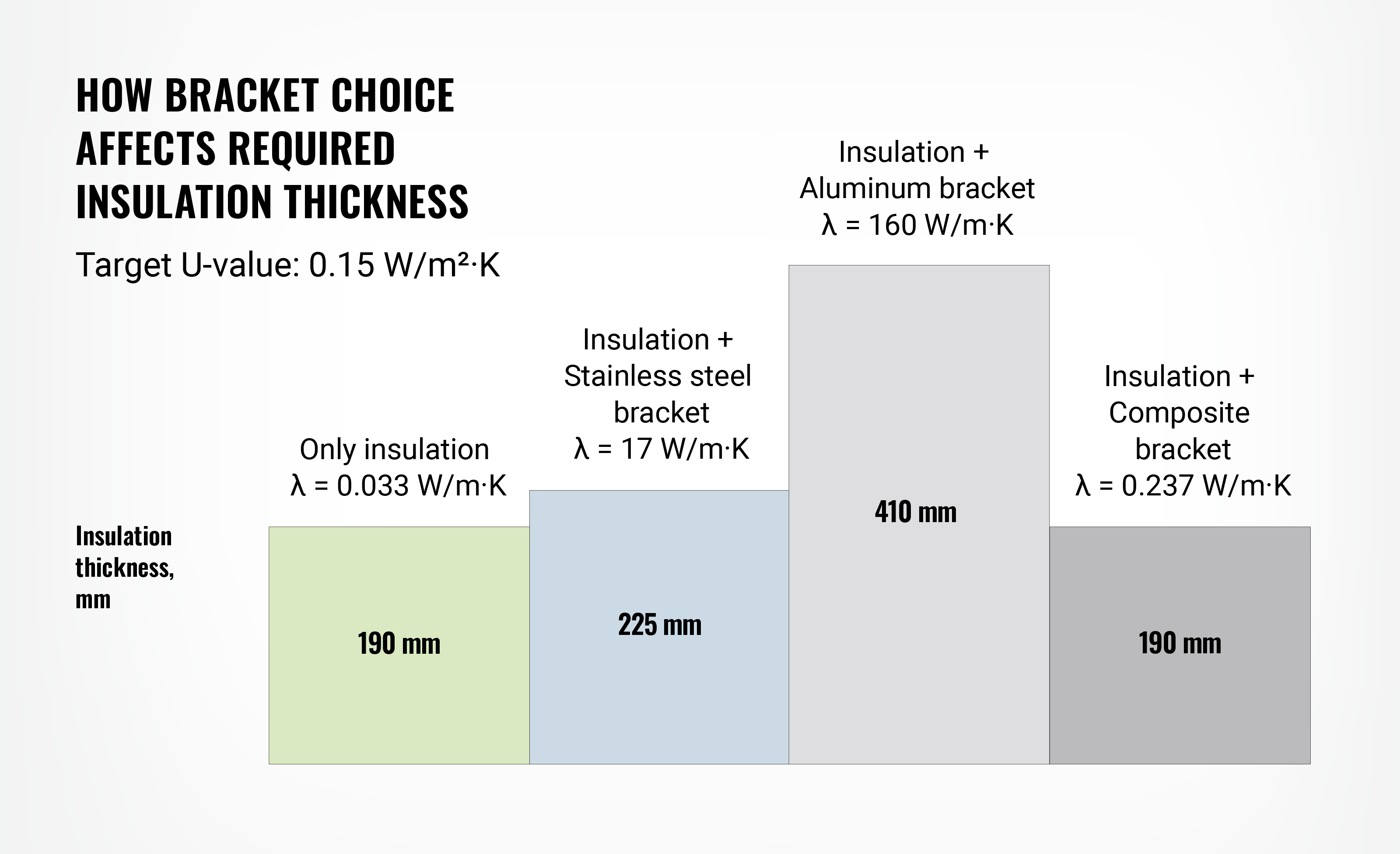
A simplified example illustrates the scale: without significant thermal bridges, a target U-value of 0.15 W/m2K may be achieved with roughly 190 mm of insulation. When wall brackets and the resulting ΔU are accounted for, achievement of the same target can require more than 410 mm of insulation. This difference can result solely from bracket material and design. With aluminum brackets (high conductivity), the required compensation may become so large that standard bracket lengths are no longer sufficient for the increased insulation thickness. From an energy-performance standpoint, brackets with thermal breaks or stainless-steel brackets are often preferable, as their thermal bridging effect is typically lower than aluminum.

An example of how brackets affect required insulation thickness

In ventilated facades, wall brackets and fasteners penetrate the insulation and introduce point thermal bridges. To achieve a U-value of 0.15 W/m2K (STR 2.01.02:2016, LST EN ISO 6946, LST EN ISO 10211:2017) with aluminum brackets, the insulation thickness should be more than double that of an assembly without thermal bridges.

Bracket thermal conductivity highlights a core design question: how can the fixing system be designed to satisfy both imposed structural loads (e.g., wind, self-weight) and thermal requirements—without driving insulation thickness up unnecessarily?

Brackets as part of an energy-efficient facade solution

The conclusion is straightforward: if the goal is to optimize energy performance, brackets should be considered as part of the insulation system and thermal calculation because they drive the ΔU correction and therefore the required insulation thickness when targeting a certain U-value. This requires a move from component-level optimization to system-level design, where thermal, structural, and practical installation factors are addressed together.

“Essentially, the design comes down to an optimization problem: ensuring mechanical integrity while balancing energy efficiency and overall wall thickness. Ultimately, the best solution is the one that optimizes the project’s life‑cycle cost without compromising the architectural vision. That’s why facade performance cannot be optimized by looking at components in isolation,” adds Alex Lalla. 

In practice, an effective approach is to optimize brackets as part of the whole facade system: reduce thermal bridging (material choice, thermal break), reduce the number of fasteners where structurally feasible, and ensure the thermal calculation (ΔU) matches the designed fastener setup.

Conclusions: from design intent to measurable performance

Closing the gap between calculated and actual performance requires an integrated approach in which the fixing system (brackets, fasteners, spacings), insulation, and ventilation cavity are designed together from the earliest stages.

Ventilated facades are systems: performance depends on how all the components work together. Details that look minor—such as bracket material and quantity—can have an outsized impact on overall heat transfer, which is why the “weakest link” in the overall thermal performance is often the fixing system.

What this means in practice (a checklist)

  • Treat brackets and fasteners as part of the insulation system and thermal calculation (ΔU), not just load-bearing elements.
  • Optimize bracket material and design (e.g., thermal breaks) to reduce thermal bridging.
  • Do not rely on increasing insulation thickness alone—first identify whether ΔU can be reduced through the fixing solution.
  • Balance thermal and structural requirements at a system level (loads, spacings, buildability, fire and moisture constraints).
  • Make sure the designed fastener spacings and details are buildable on site and match the assumptions used in calculations.

FAQ: Brackets, fasteners, and thermal bridges in ventilated facades

In the next article, the focus shifts to broader facade risks and requirements, including moisture performance and fire safety in ventilated facade systems.

design guide

Take a closer look at the Ventilated Facades Design Guide.

Explore our ventilated facade solutions

We offer ventilated facade solutions for new buildings as well as renovations. There are solutions for wooden or metal frame buildings, masonry, or concrete walls, with one or two layers of insulation for various facade facings.


Share this page on:

Related Articles

A white building with ventilated facade is seen from beneath with a light blue sky in the background.

Small Gap, Big Impact: Rethinking Ventilated Façades for Tomorrow’s Climate

It is the insulation solution – and how it performs within the façade system – that still largely determines the thermal, acoustic, fire, and moisture behavior of the external wall. Ventilated façades meet all these requirements.
Read more
A wooden facade against a blue sky

What really determines the performance of a ventilated facade?

A ventilated facade is often considered a safe and sustainable solution when it comes to moisture protection. But what actually determines the performance of a ventilated facade? Read more in this article, which is part of a series of technical articles on the subject.
Read more