



This is a cache of https://www.paroc.com/en/applications/technical-insulation/hvac/cooling-pipes. It is a snapshot of the page as it appeared on 2026-02-04T00:23:42.450+0000.
Insulation for Cooling Pipes | Paroc Applications
Skip to main content

PAROC® insulation for chilled water pipework

Efficiency and Protection for Cooling Systems

Liquid-filled pipes for comfort cooling need to be insulated to limit the flow of heat and moisture from the environment to the pipes. This helps to prevent thermal transfer and condensation.

Over time, condensation can damage pipework, shortening its life. This can cause damage and discoloration to ceilings and floors. In the worst case, it can lead to mould growth in adjacent parts of the building.

PAROC insulation solutions for cooling pipes help to maintain a comfortable indoor climate. At the same time, high-quality insulation can also contribute to energy savings and reduction of operating costs.
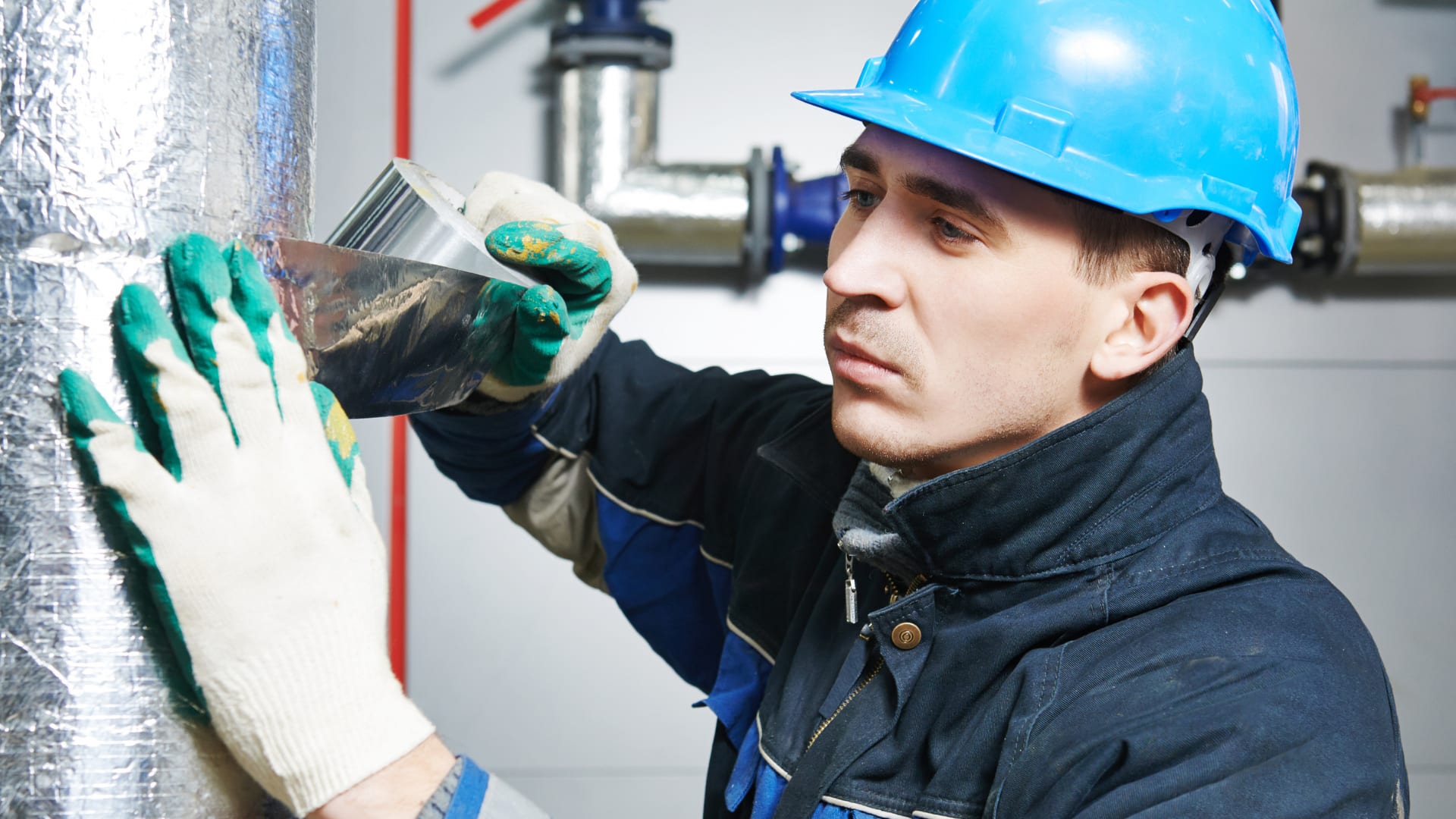

Man installing insulation for cooling pipes

Benefit from Cooling Pipe insulation

Prevent condensation, icon

Prevent condensation

Cold pipes in warm rooms may need to be insulated to reduce the risk of external condensation forming. The factors that determine whether water vapour condensation forms on the pipe are the surface temperature of the pipe, the ambient air temperature, and relative humidity. To prevent condensation on the insulation surface, the pipe needs to be insulated so that the surface temperature of the insulation is higher than the dew point of the surrounding air. 

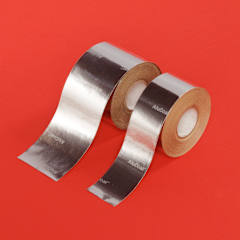
To minimise the risk of moisture ingress, PAROC® products have a water vapour-resistant barrier in the form of a reinforced aluminium foil called AluCoat. This in combination with PAROC® tape can enable an easy and correct installation with precise joint seals. No additional gluing is needed.

Reduce thermal gain, icon

Reduce thermal gain

Well insulated chilled water pipes help to reduce thermal gain and ensure that the contents are transported to the destination with maximum efficiency. PAROC® insulation products with low thermal conductivity* and high thermal resistance can contribute to limited heat gain and temperature changes, which in turn can lead to lower and more efficient energy use and reduced operating costs.

*Please consult the local datasheet for product specific information.

Avoid fire hazards, icon

Avoid fire hazards

When tested to EN 13501-1, PAROC® products offer the highest fire class either Euroclass A1 or A2-s1,d0. Our stone wool insulation products are non-combustible. They do not burn or contribute to fire spread. They will not produce any smoke or very limited amount of smoke, nor do they produce flaming droplets. The softening temperature of stone wool products is *over 1000°C. The fire performance of stone wool does not deteriorate with high temperatures, nor with time. The surface temperature of faced products must not exceed 80°C.

*Owens Corning internal test results, June 2023-24 for normal quality control/FPC.
Quick installation, icon

Quick installation

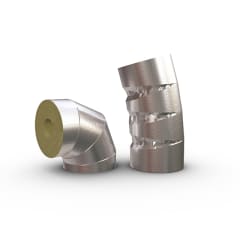
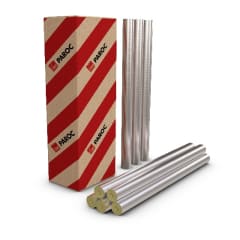
With a length of 1.2m, PAROC® Hvac Sections make installation quick and help to reduce the number of joints and potential thermal bridges, when comparing to the 1.0m insulation solutions. PAROC® Hvac Sections also have a self-adhesive overlap and in combination with a suitable tape make installation easy.

Certificates and Declarations

Symbol for CE

CE

Symbol for M1 certificate

M1

symbol for BREEAM certificate

BREEAM

Symbol for EUCEB certificate

EUCEB

Symbol for LEED certificate

LEED

symbol for BES 6001 certificate

BES 6001

Our PAROC insulation solutions are certified with CE and may help your project qualify for BREEAM or LEED, enabling you to build to high standards. To help you make informed decisions, all our product declarations, DoP and EPDs, are made available on our website. We can also supply you with additional mandatory and voluntary certifications related to responsible sourcing, emissions and safety, such as BES 6001, M1, Blue Angel, and Nordic Swan.

PAROC Calculus 

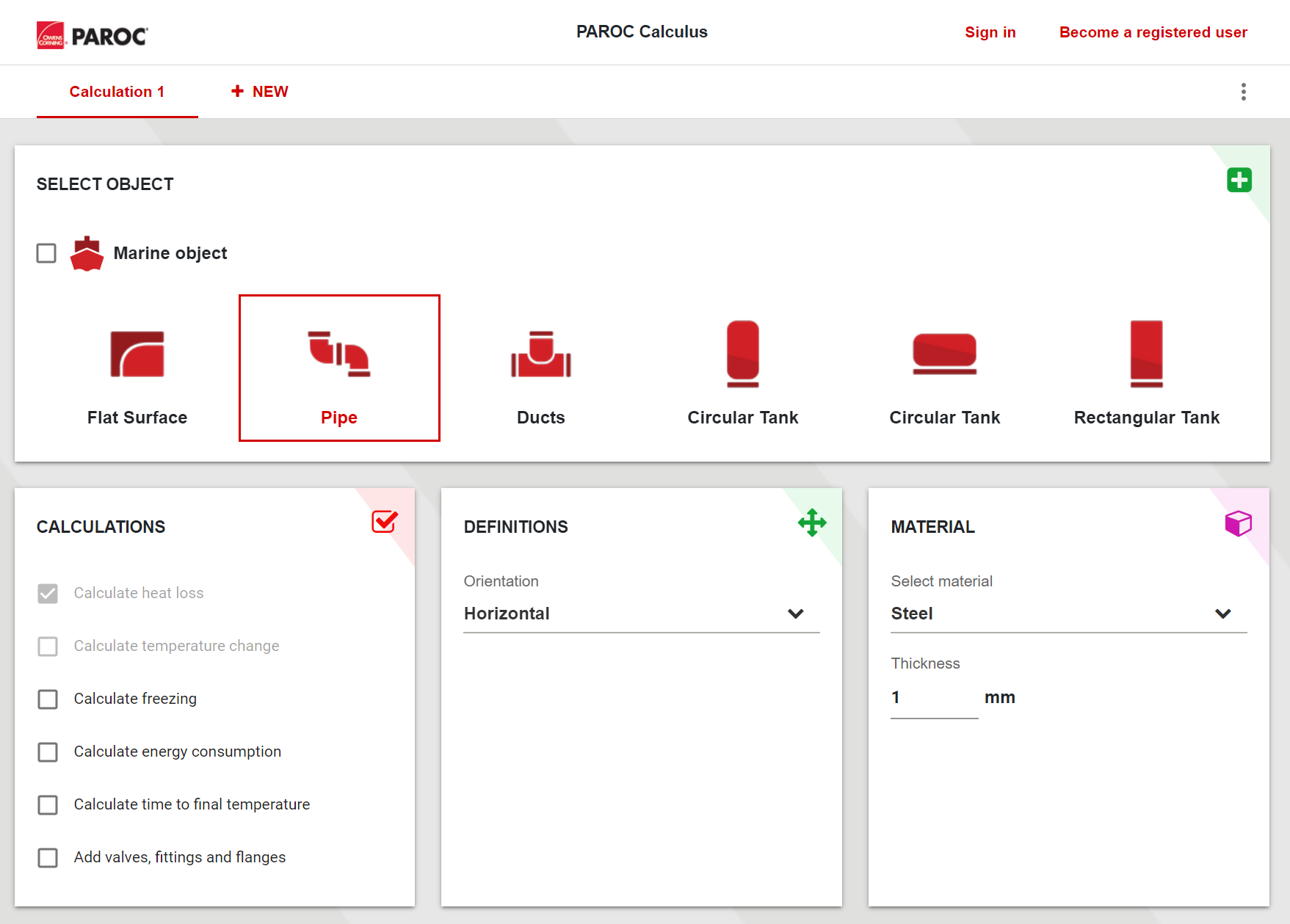
PAROC Calculus is a technical insulation calculation program for dimensioning thermal insulation for various applications in the HVAC and Process industries.

PAROC Calculus features:

• Easy-to-use interface; works on PCs, tablets, and cellphones

• Calculations of heat losses, surface temperatures, and temperature drop in pipes, ventilation ducts, process industry tanks, valves, and flanges

• Simple input of pipe diameters and duct dimensions (predefined)

• Correcting for thermal bridges of pipe and duct suspensions

• Print calculations as a PDF. Multiple simultaneous printouts in PDF are possible

• Saving projects and customizations (for registered users)

• Calculations based on the ISO 12241:2022 standard

Screenshot of Paroc Calculus software interface showing insulation calculation results for HVAC applications

Sustainability news

Find below the latest articles and blogs on our sustainability efforts.

Didier Vercruyssen, OC Paroc Project Manager, Andreas Magnusson, Project Manager PEAB, Stefan Kristersson, Construction Manager PEAB,  Lukasz Wala, OC Paroc EU Project & Construction Manager, Blazej Budziszewski, OC Paroc Electricity & Automation Manager

Trust, safety, and shared goals drive the reinvention of Hällekis

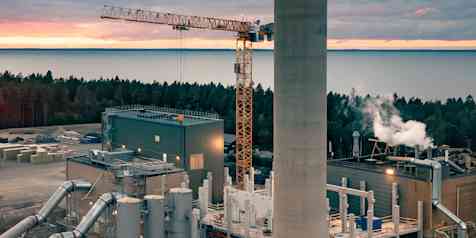
Exceptional projects require exceptional partnerships. This is certainly true of our ambitious Reinventing Hällekis project, where our Hällekis stonewool plant in Sweden, is transforming its melting process from coke-fired furnaces to state-of-the-art electric melting technology.
Read more
The new facility in Hällekis, seen from above.

See the future take shape – Time-lapse from Hällekis

Over the summer, our manufacturing facility in Hällekis has undergone major changes as part of our transition project to electric melting technology. Now we invite you to take a look behind the scenes.
Read more
A building that is undergoing an energy renovation of the facade.

Energy Renovations: A Key to Saving Energy in Europe

Improving the energy efficiency of existing buildings is crucial for reducing energy consumption and achieving the EU's target of zero-emission buildings. Energy renovations have the potential to address three issues at once: energy costs, emissions, and living conditions.
Read more

Contact Paroc Technical Insulation