




Across the EU, climate change and aging building stock are putting façades under pressure. From a technical and financial standpoint, as many as 35 million buildings will require energy renovation by 2030. Building professionals are therefore faced with a long list of choices. It is the insulation solution – and how it performs within the façade system – that still largely determines the thermal, acoustic, fire, and moisture behavior of the external wall. Ventilated façades meet all these requirements: the combination of a ventilated cavity and the right insulation protects the structure, manages moisture, and supports long-term performance.
Small Gap, Big Impact: Rethinking Ventilated Façades for Tomorrow’s Climate
Written By Paroc•Date Published 2026-03-02
As external walls are exposed to frequent and intense wetting, the risks associated with aging and underperforming façades become increasingly evident. For building professionals, the main consequence of this is clear: both energy efficiency and moisture management matter more than ever – and they must work together. At the same time, cost-efficient façade solutions are in high demand across new-build and renovation projects. In this equation, insulation plays a central role not only in meeting energy targets but also in defining how the façade behaves in terms of fire safety, moisture control, and long-term durability. The challenge is to meet tight budgets and high performance expectations without compromising safety and quality over the lifetime of the building.
“Insulation tends to come last in the design process, but in reality, it defines how the façade performs thermally, handles fire, and manages moisture throughout its lifetime,” says Susanna Tykka-Vedder, OC Paroc Product Leader.
The most future‑proof façade solution
The most future‑proof façade solution
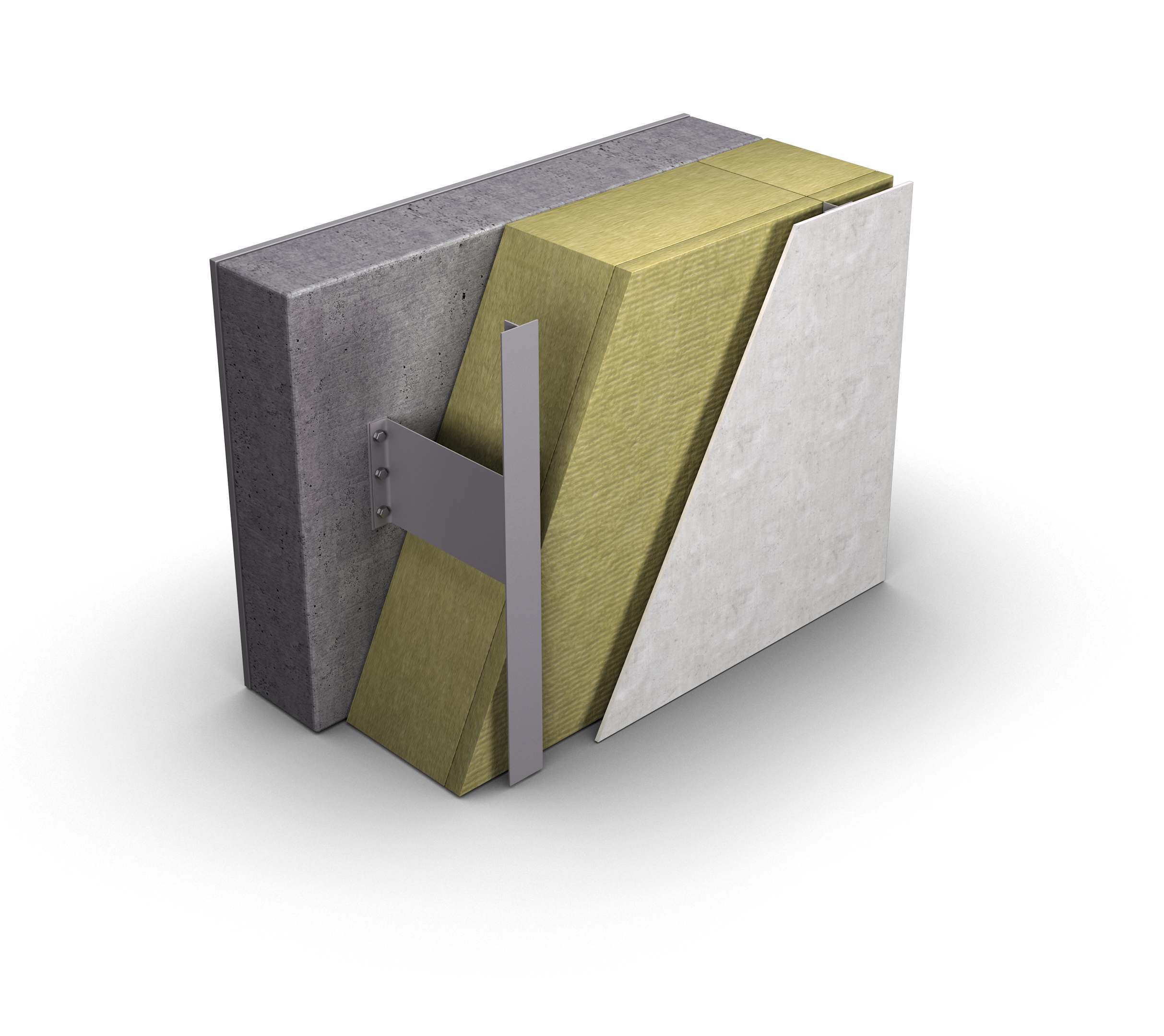
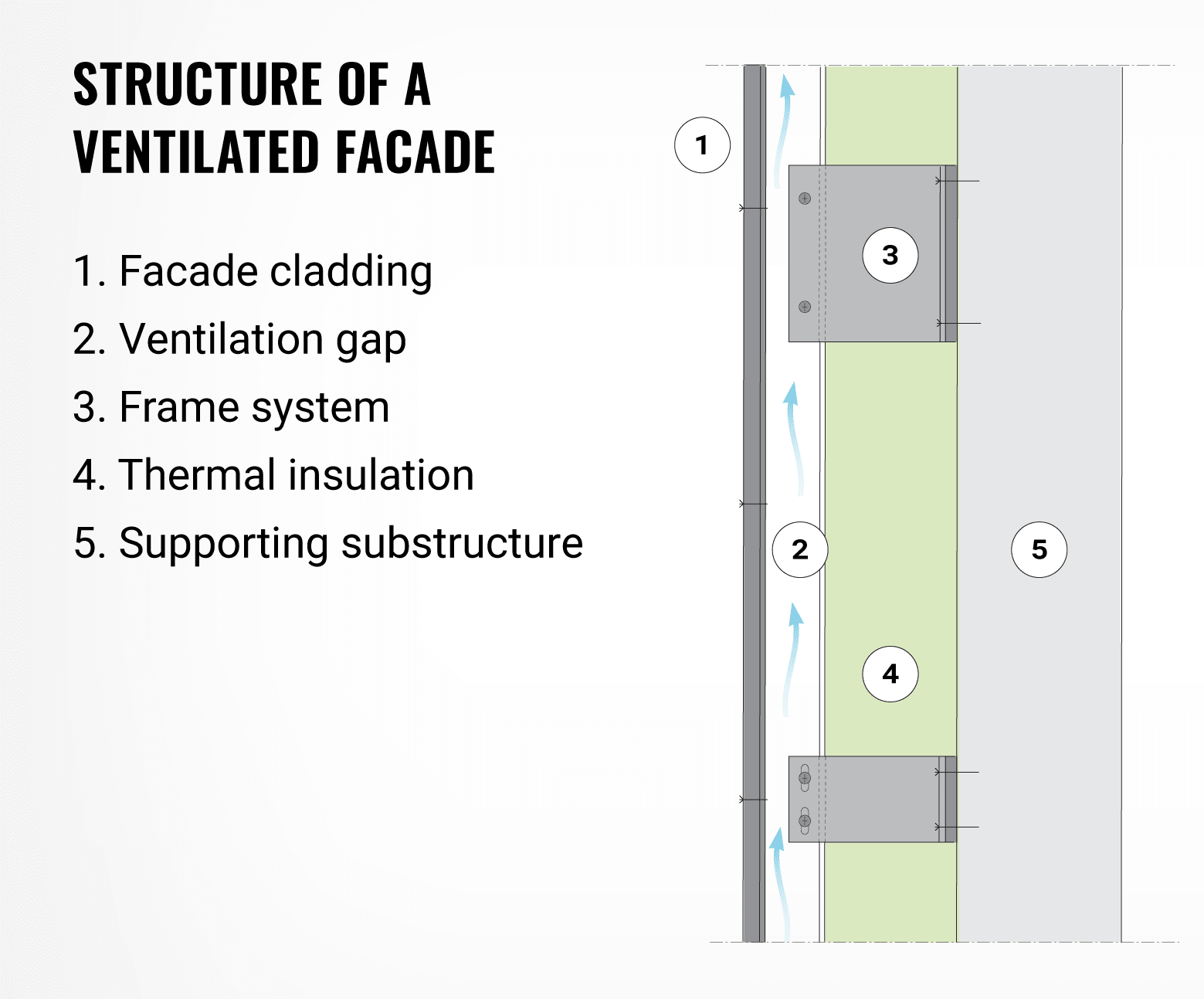
A ventilated façade is a structure in which a continuous ventilation gap is placed between the external cladding and the thermal insulation layer. The cladding is fixed to the load-bearing structure through the insulation using a sub-frame or brackets. The ventilation gap is connected to the outside air via openings at the bottom and top of the wall – and, where needed, at intermediate levels – creating a continuous natural air exchange that improves the moisture safety of the wall.
The same principle applies in both new buildings and renovation projects. By separating the weather-exposed layer from the insulated load-bearing wall and letting controlled air movement manage moisture between them, ventilated façades are a predictable way of upgrading performance without trapping moisture in the structure.
“Ventilated façades are not just one option among many. Rather, they are arguably one of the most future‑proof façade solutions for both new-build and renovation projects. The small gap between cladding and insulation turns a static wall into a dynamic moisture-management system,” says Susanna.

Susanna Tykka-Vedder, OC Paroc Product Leader
Why building professionals keep choosing ventilated façades
Why building professionals keep choosing ventilated façades
A well-designed ventilated façade brings together several performance benefits that are difficult to achieve with closed systems:
- Long-term weather and moisture safety. The ventilated gap and external cladding shield the insulation and structure from rain, splash water, and wind-driven moisture.
- Flexible energy performance. With the right combination of subsystem and insulation, a wide range of U-values can be achieved without compromising moisture safety.
- Straightforward renovation options. The adjustable sub-structure with soft and breathable insulation material makes it possible to over-clad existing masonry or concrete façades while allowing the original wall to dry out.
- Fire safety by design. The use of non-combustible components and materials enables robust and predictable fire performance.
Taken together, these strengths explain why ventilated façades are increasingly seen as a reliable way of responding to changing climate loads, evolving insulation solutions, and the practical realities of renovation – provided that the system is designed and executed as a whole.
The ventilation gap: the small space that makes or breaks your façade’s performance
The ventilation gap: the small space that makes or breaks your façade’s performance
In a ventilated façade, the cavity between cladding and insulation is far more than “empty space”. It is an active functional layer that largely determines whether the façade can cope with rain, construction moisture, and indoor humidity, all of which inevitably find their way into the structure over time.
Outdoor air enters the cavity at the bottom of the façade and exits at the top. Because the driving forces behind this airflow are modest, performance depends less on theory and more on execution. It depends on the continuity of the gap, the size and placement of openings, and on how well the cavity stays open once brackets, fire barriers, and normal installation tolerances are in place. When these conditions are met, the gap becomes a controlled pathway that allows water to drain away and residual moisture to be removed from cavity surfaces and the outer face of the insulation.
“Façade ventilation is there to remove all the extra moisture that inevitably ends up in the external wall – from construction moisture and indoor humidity to wind-driven rain. The real challenge is keeping the cavity working regardless of very different climates, building heights, and detailing conditions,” says Susanna.
Seen this way, the ventilation gap is not a passive detail but a performance-critical layer. If it works as intended, it supports both moisture safety and long-term thermal performance. If it is compromised, even a well-specified façade system can fall short of expectations.
Moisture management: three jobs for one cavity
Moisture management: three jobs for one cavity
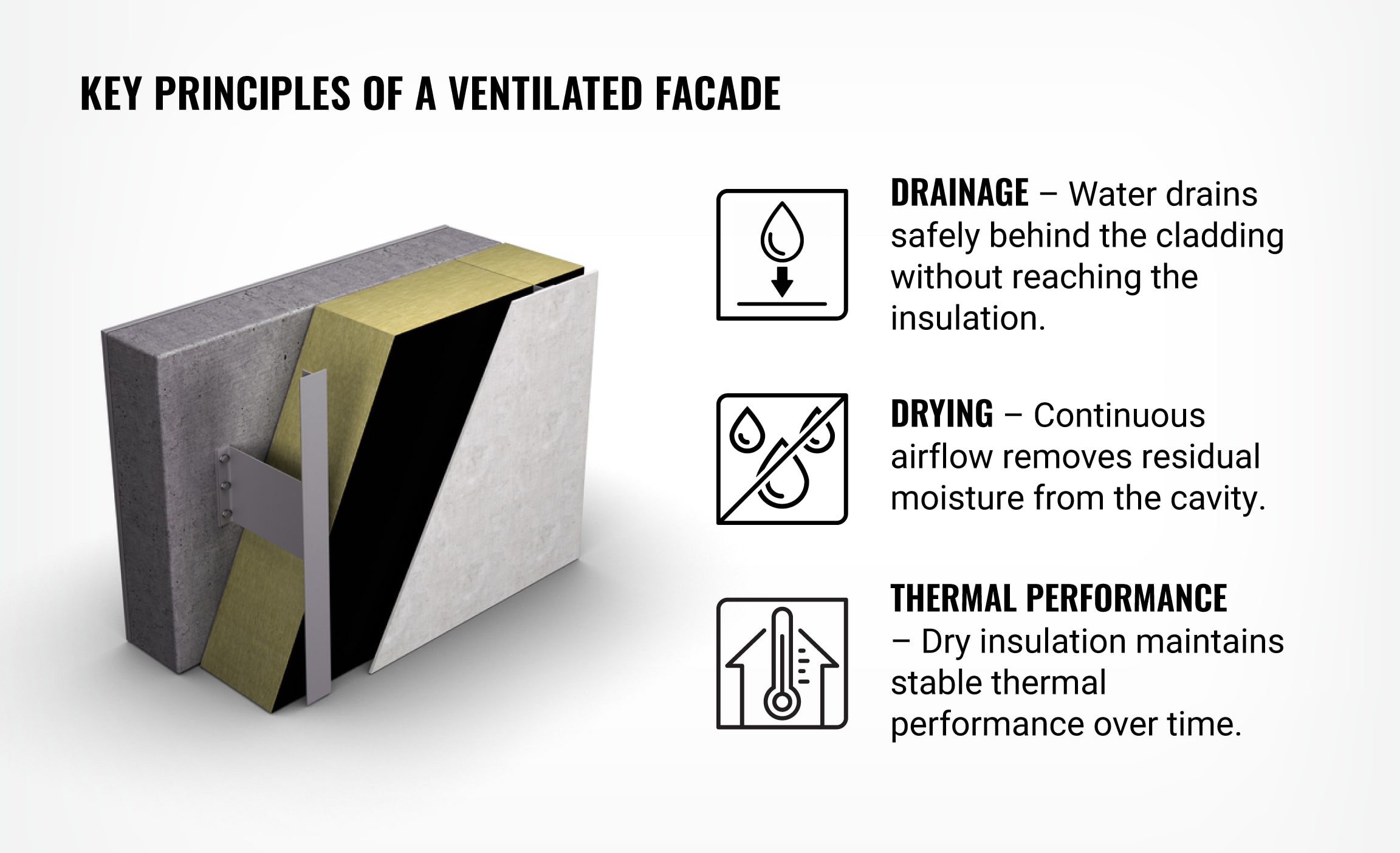
From a moisture-management perspective, the ventilation cavity performs three critical functions at the same time:
- Drainage – it acts as a capillary break and drainage plane, allowing water that passes the cladding to run downwards without being drawn into the insulation or load-bearing structure.
- Drying – the stack effect and wind-induced airflow create a gentle but continuous movement of air that removes vapor and surface moisture after rain events and during the drying of construction moisture.
- Protection of thermal performance – by keeping the inner construction layers dry over time, the cavity helps stabilize the insulation material’s declared thermal conductivity and reduces the risk of mold growth, freeze–thaw damage, and corrosion in fixings.
Modelling work carried out by VTT (VTT Technical Research Centre of Finland Ltd) for Paroc is based on multi-year hygrothermal simulations using WUFI. The simulations examined ventilation cavity airflow, moisture accumulation, and drying under varying conditions, including different building heights, façade materials, and levels of wind-driven rain exposure in Nordic and Central European climates. The results show that, as façade height, mass, and exposure increase, the ventilation demand of the cavity rises significantly – placing greater emphasis on correct gap dimensioning and detailing.
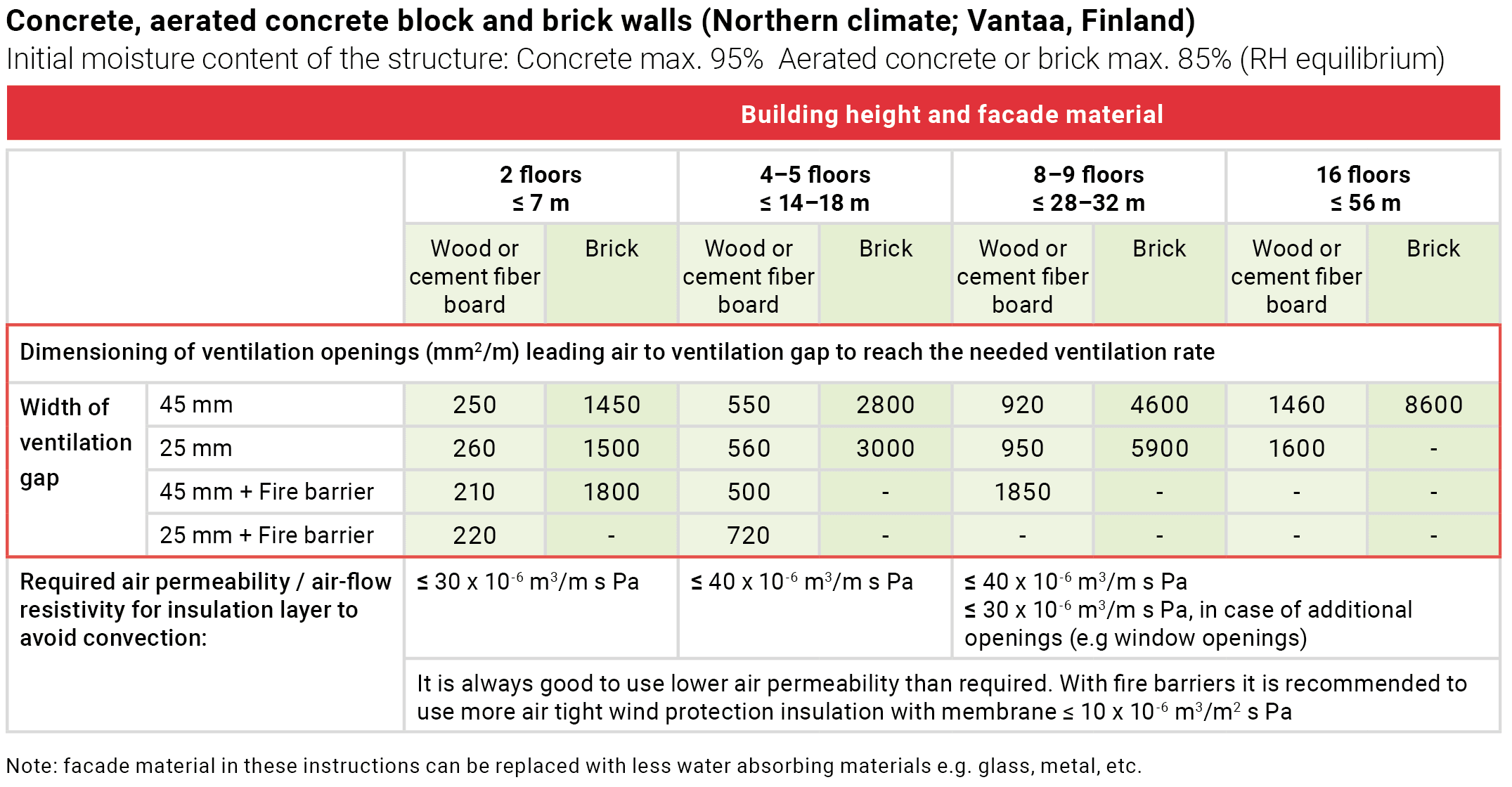
In low-rise buildings, effective cavity ventilation can be achieved with smaller inlet areas, provided the façade cladding is lightweight and dries quickly. However, when ventilated cavities involve fire barriers, it is essential to add more inlets to ensure sufficient airflow.
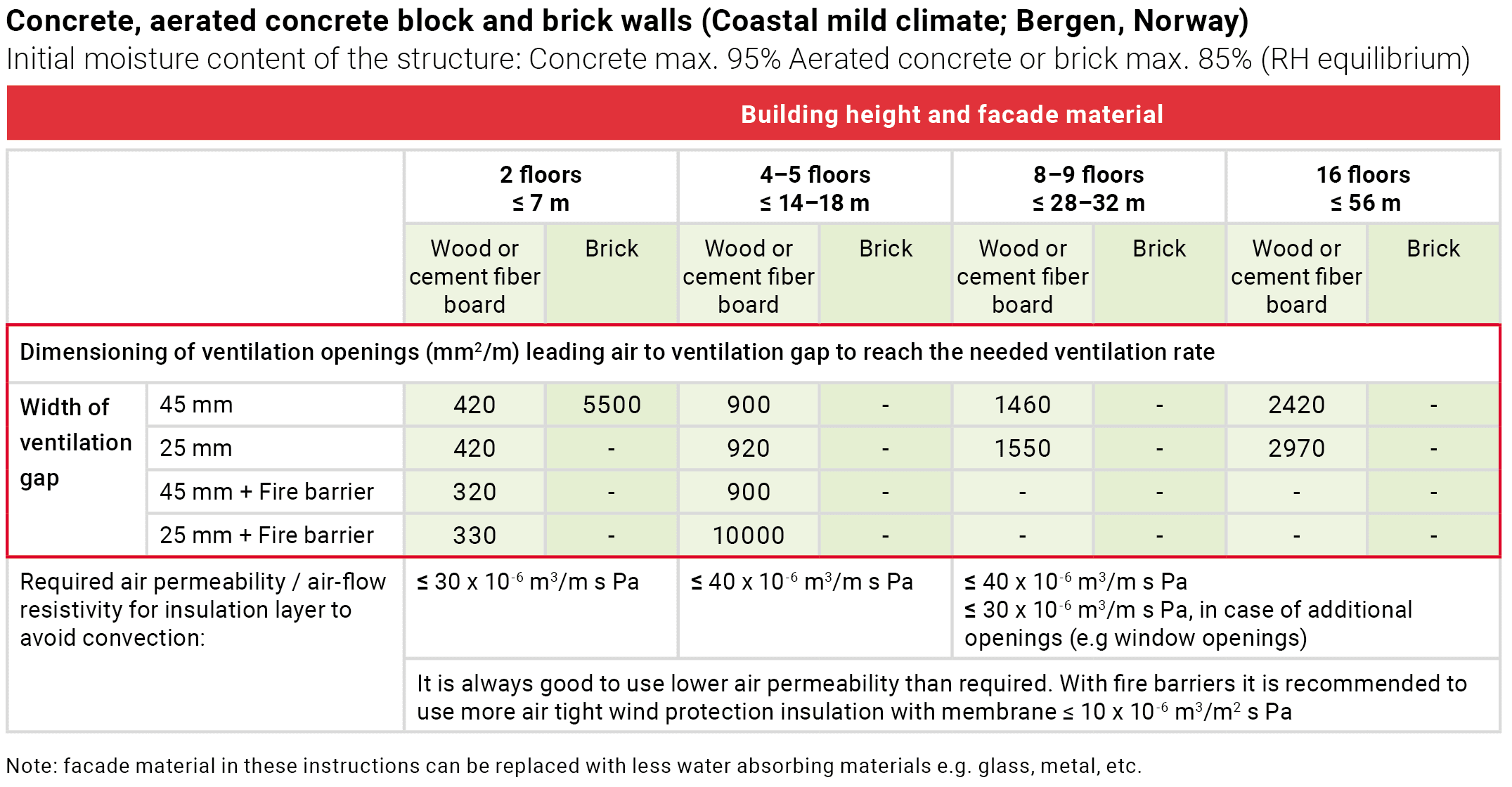
In low-rise buildings, effective cavity ventilation can be achieved with smaller inlet areas, provided the façade cladding is lightweight and dries quickly. However, when ventilated cavities involve fire barriers, it is essential to add more inlets to ensure sufficient airflow.
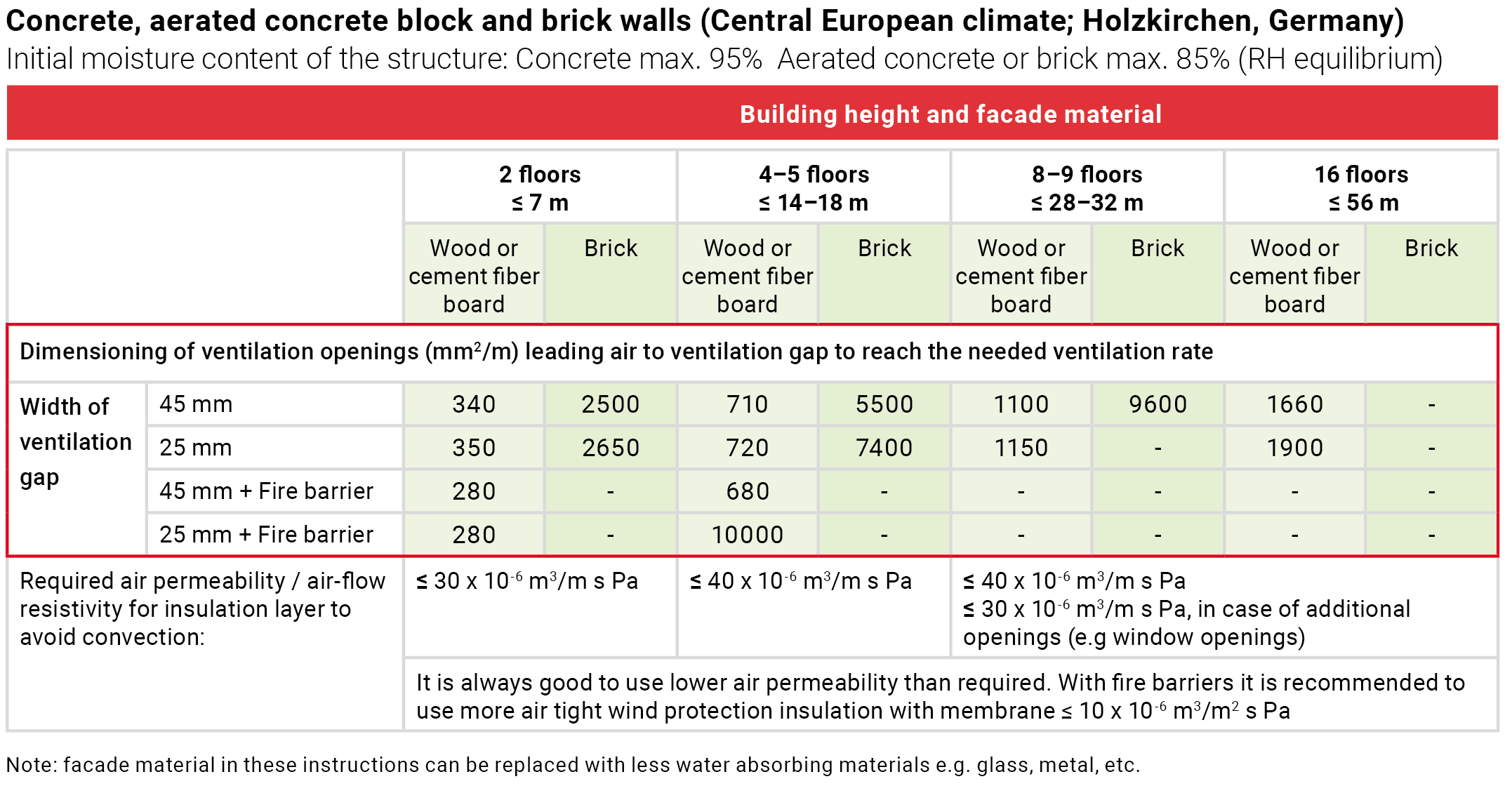
In low-rise buildings, effective cavity ventilation can be achieved with smaller inlet areas, provided the façade cladding is lightweight and dries quickly. However, when ventilated cavities involve fire barriers, it is essential to add more inlets to ensure sufficient airflow.
Paroc recommendations for ventilation openings
Paroc recommendations for ventilation openings
In ventilated façades, the performance of the ventilation cavity depends less on the nominal width of the gap and more on how effectively air can enter and leave the cavity. According to Paroc’s ventilated façade design guidance, the size, continuity, and placement of ventilation openings are the key parameters governing airflow in the cavity – particularly once fire barriers and fixings are introduced.
Paroc’s guidance shows that, while cavity width remains constant, horizontal fire barriers can dramatically reduce the effective free ventilation area. As a result, increasing gap width alone does not compensate for insufficient or obstructed openings. In practice, the free opening area has a much greater impact on airflow, moisture control, and pressure moderation than the nominal cavity dimension.
An example based on Paroc design guidance:
An example based on Paroc design guidance:
In a façade with a 45 mm ventilation gap, the free ventilation opening without fire barriers is 37 530 mm² per meter [(1000 mm × 45 mm) - (1.66 × 45 mm × 100 mm)]. When a horizontal fire barrier is added, the effective opening size may be reduced by up to 95%, leaving only 1876 mm² per meter of free ventilation area.
Impact of fire barrier
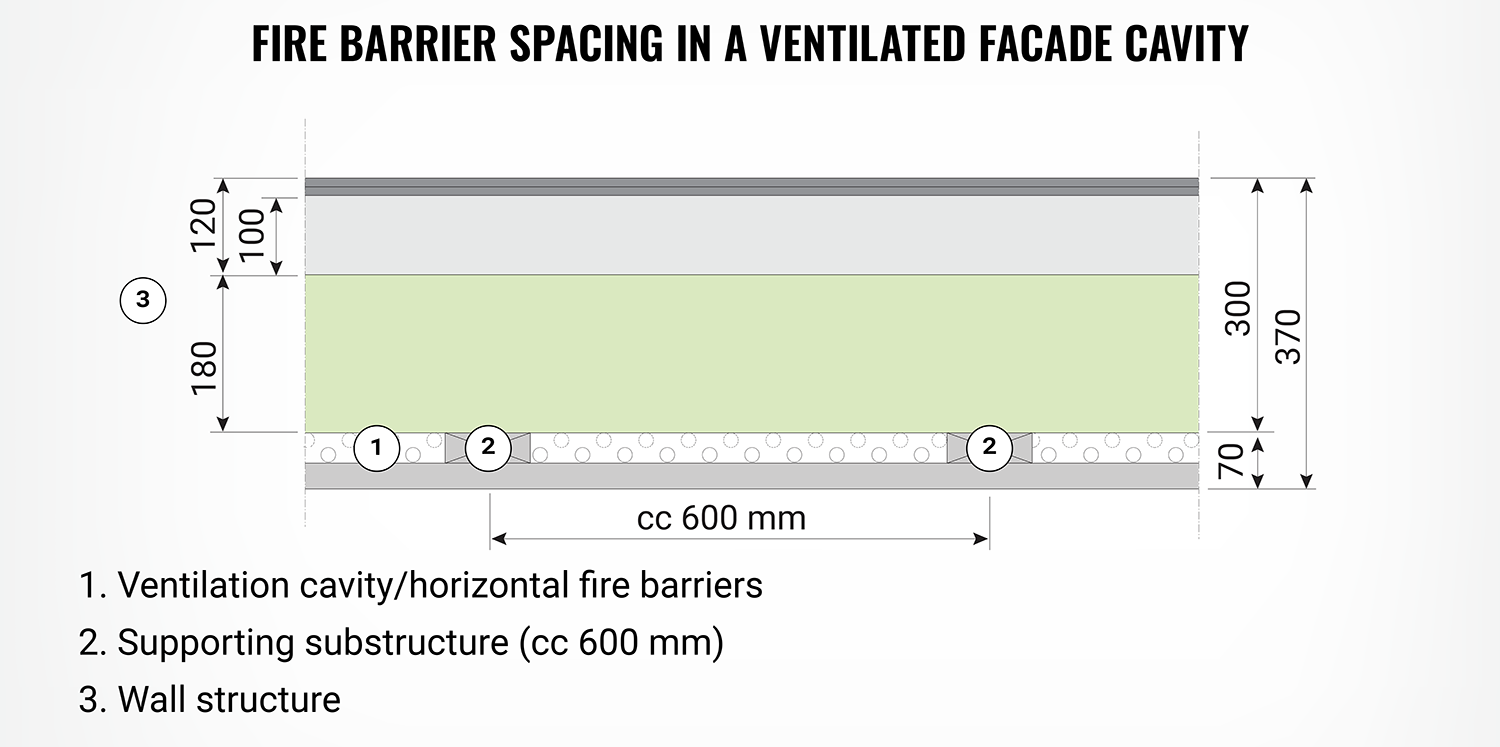
This example illustrates why ventilation openings must always be dimensioned with fire barriers and detailing in mind. A wider cavity cannot compensate for poorly sized openings, whereas well-dimensioned ventilation openings can maintain cavity performance even in more complex façade designs.
In low-rise buildings, effective cavity ventilation can be achieved with small inlet areas, provided the façade cladding is lightweight and dries quickly. However, when ventilated cavities involve fire barriers, it is essential to add inlets for sufficient airflow.
Are we still dimensioning the gap correctly?
Are we still dimensioning the gap correctly?
Because the ventilation gap performs these critical functions, small design or execution errors can have outsized consequences. Recent design guidance points to two essentials in particular:
- The gap must stay open in reality, not only in drawings – even after brackets, fixings, and horizontal fire barriers have been installed.
- The insulation facing the gap must limit unwanted air movement to avoid wind-washing and internal convection that can undermine thermal performance.
Getting this “small space” right is therefore not about leaving a nominal 20 or 30 millimeters. It is about combining adequate width, well-designed openings, compatible fire stopping, and the right insulation. Then the cavity can reliably do its job over the full height and service life of the façade.
“Codes will tell you the minimum, but they won’t tell you what is optimal for your building. The ventilation gap has to be sized for the actual height, exposure, and façade build-up you are designing,” says Susanna.
For design teams, a few practical questions can sharpen up the discussion about the next project:
- What wind-driven rain loads and exposure categories are we really designing for?
- How tall is each façade zone, and where should the cavity be ventilated in and out?
- Do brackets, fire barriers, and installation tolerances leave the free gap we think we have?
- How do national regulations interact with manufacturer recommendations in this case?
Small details, lasting impact
Small details, lasting impact
Now we have seen how the ventilation gap, insulation, and cladding together turn a simple wall into a ventilated façade system that can manage moisture, support energy performance, and protect the structure under increasingly demanding conditions. When the cavity is treated as a working layer, the whole system becomes more robust, predictable, and easier to renovate over its life cycle. The next few articles will build on this foundation by looking at how to dimension and ventilate the gap. The articles also explore insulation performance, moisture and fire risks, brackets, and overall system choices.
Explore Our Ventilated Facade Solutions
Explore Our Ventilated Facade Solutions
We offer ventilated facade solutions for new buildings as well as renovations. There are solutions for wooden or metal frame buildings, masonry, or concrete walls, with one or two layers of insulation for various facade facings.