


This is a cache of https://www.paroc.com/en/article/paroc-an-important-part-of-future-construction-methods. It is a snapshot of the page as it appeared on 2026-02-22T01:05:53.271+0000.
Paroc - An important part of future construction methods | Paroc Article
Skip to main content
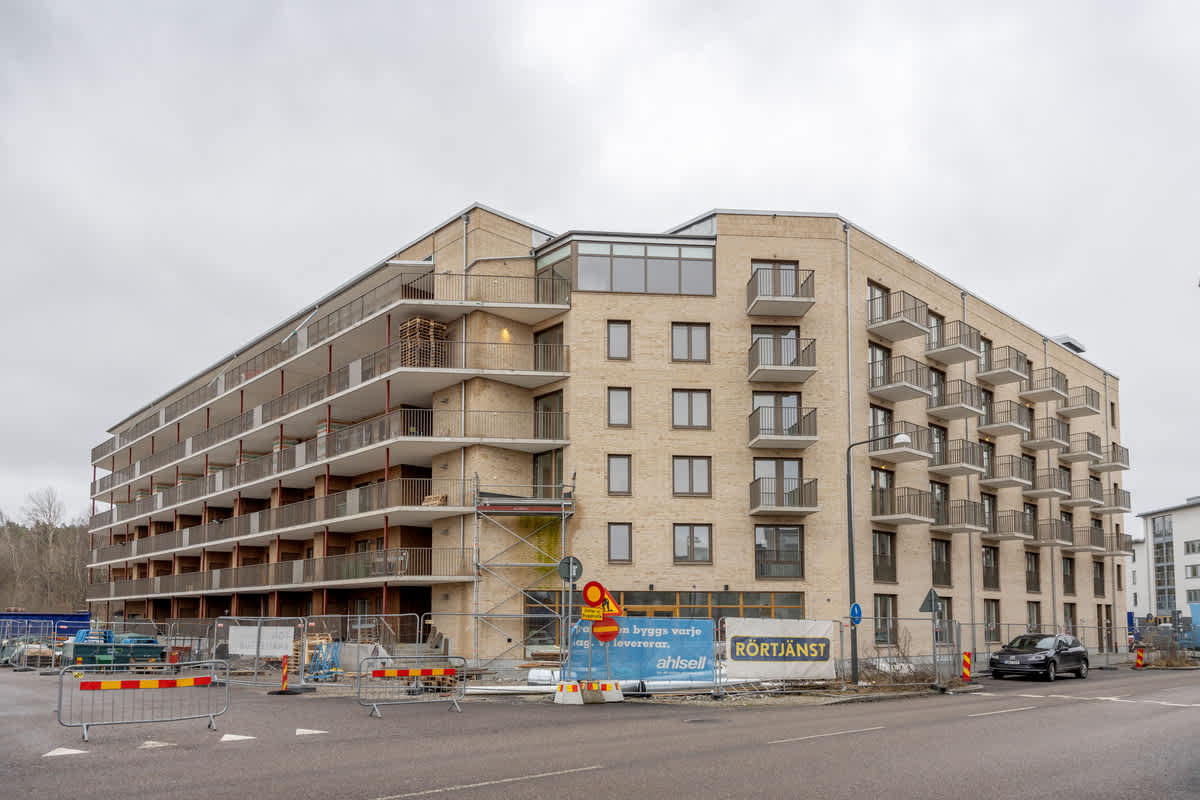
The Tamarinden residential in Örebro, Sweden.

Paroc - an important part of future construction methods

Written By ParocDate Published 2025-05-07

When Tamarinden, a new residential area in Söderbyängen in Örebro, Sweden, is built, sustainability will be a focus. On completion, its energy consumption is expected to be 30 percent lower* than normal. This result is due, in part, to Paroc.

The new city area, with a total of 800 residences, a preschool, and business premises, is the first of its kind in Sweden. Using solar panels and batteries, the buildings themselves will be able to produce, store, and share energy with each other in a local energy grid. The ambition is for Tamarinden to be a prototype for how Sweden can build more energy-smart buildings in the future and thus help to reduce the environmental footprint. Preliminary studies by Örebro Municipality* show that Tamarinden's energy solution can provide energy savings of 30% and reduce power demand by 50%.

– Tamarinden is an innovative and exciting project through which we can change how we build energy-efficient infrastructure. The facts that we are doing this in collaboration with builders and with the support of research in the field of energy transition mean that this is both educational and developmental, says Christer Lundqvist, project developer at ÖrebroBostäder, the local municipal housing company.
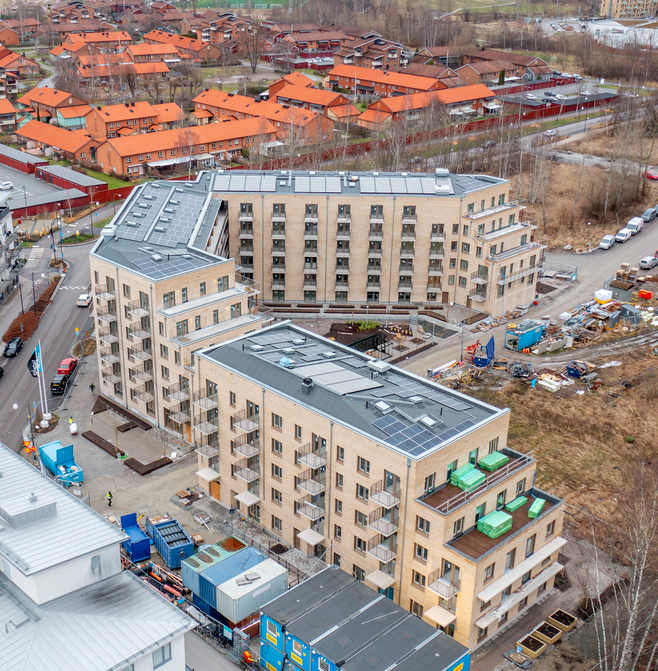

The new Tamarinden residential area in Örebro, seen from above.

A New Way of Building

The development of Tamarinden is based on close cooperation between ÖrebroBostäder and various contractors. This particular part of the project consists of 139 rental apartments divided between two buildings with a garage underneath. It is expected to be completed in spring 2025.

Mathias Niia works as a site manager on the project and describes the work with Tamarinden as “being a part of creating the future.” 

– This way of building is new to us and it's clear that it will be a challenge. We constantly have to make sure that all parts of the project talk to each other. But this is the way we have to start building if we are to reach the climate goals – Sweden has to get here, he says. 

The idea is that left-over electricity from one building could be used by another – creating its own energy ecosystem in the district. One of the pieces of the puzzle is using solar thermal collectors to heat water.

– It should even be possible to disconnect residential areas from the electrical grid, if necessary, continues Mathias Niia.

To succeed in building in an energy-smart property you need building materials that are both of high quality and meet the requirements. That's why the contractor looked at Paroc's product range when it came to choosing insulation material.

– Paroc had energy-smart overall solutions for the applications I was working with. This was something they were pretty much alone in, so the choice was not particularly difficult. In addition, choosing a supplier that is geographically close to us was beneficial. It helped minimize our environmental impacts due to shipping as it reduces transport distances, Niia says.

Portrait of Mathias Niia, site manager at the project.

Emma Linder, Regional Sales Manager for building insulation at Paroc, worked with Mathias Niia in connection with the project. She emphasizes that, when the contractor was considering insulation products for the building, the process was quick and smooth.

– The frame of the houses is made of concrete and insulated with PAROC Tento tt, Klimatskiva, with is made of non-combustible stone wool. Our insulation can also be found inside the frame, for example in the interior walls. In other words, we have delivered suitable solutions that provide both good thermal insulation and good fire protection in several parts of the buildings, Linder says. 

– Ever since the project started, we have had very good dialog with both the contractor and the dealer. When minor adjustments were needed along the way, it was no problem, she adds.

Portrait of Emma Linder, regional sales manager at Paroc Building Insulation.

The Bestseller - PAROC eXtra

PAROC eXtra has been used as an insulation solution in the internal walls of houses. It is a versatile low-density insulation with a lambda value of 0.036 W/mK and is formatted for wooden and steel studs in partition walls, external walls, sloping ceilings, and attic floors. For ventilated constructions, the product is installed as a two-layer solution together with wind protection insulation.

The insulation is easy to cut with a knife or saw. It is also easy to install in various stud constructions and stays firmly in place without support. When installing the insulation between studs, the product's oversize by 5–10 millimeters enables a good filling without cracks and gaps. PAROC eXtra comes packed in compressed packaging, which means that the trucks can deliver more packages to the construction site in each transport. 

 PAROC eXtra is one of our bestsellers. It is a flexible insulation slab that is easy to handle and has a low density, says Mikael Olofsson, Product Manager at Paroc.

– There are several reasons to use PAROC eXtra. One is to maintain energy through a low lambda-value. Also, since the insulation is non-combustible, it makes sense from a fire point of view. The product is ideal for improving sound insulation in walls. The board also has an adapted format, which means minimal waste. PAROC eXtra comes in fully sealed packs that are compressed by up to 70 percent*, which means that more can be transported on each truck going out to the construction site,  Olofsson adds. 

*Up to 70% compression of PAROC eXtra packaging is in use in Sweden.

Portrait of Mikael Olofsson, Product Manager at Paroc.

”The West Coast slab” - PAROC Tento tt Klimatskiva

Klimatskiva PAROC Tento tt is made of non-combustible stone wool for the insulation of existing and new ventilated external walls. It has been installed on the façade of houses in this part of the Tamarinden project. The slab, also known as the West Coast slab, can be used in a single-layer system or in a two-layer system in combination with another thermal insulation layer. With a two-layer system, it is easy to create an unbroken thermal insulation layer with staggered joints, which minimizes the risk of thermal bridges. Both sides of the slab are covered with natural-colored fiberglass, which facilitates product handling.

–Klimatskiva is used on the outside of the exterior wall for complete insulation and serves to protect the frame from the cold climate. It has a high density and acts as a wind protection on top of the lightweight PAROC eXtra insulation, which is often the main insulation in the frame, explains Mikael Olofsson.

– Behind a ventilated façade, there is air movement that can have a negative effect on the lightweight insulation; the air must be allowed to stand still because that is what insulates. PAROC Tento tt is one of our most effective insulations, with a lambda value of 0.033 W/mK. It also has a higher density that can cope with the expected air movement in a ventilated façade. PAROC Tento tt comes in a large format, which makes it easy to cover large areas directly, Olofsson adds.

The Cellar Ceiling Lamella – PAROC CGL 20cy

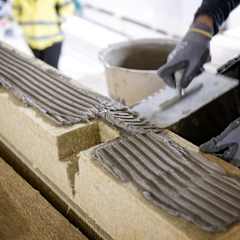
PAROC SW Glue is applied to PAROC CGL 20cy cellar ceiling lamellla.
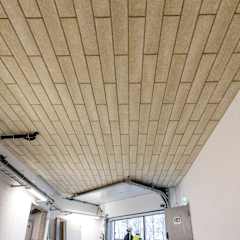
PAROC CGL 20cy cellar ceiling lamella is installed in the ceiling of a parking garage.
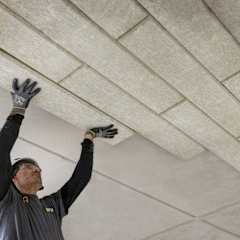
A person is installing PAROC CGL 20cy cellar ceiling lamella.
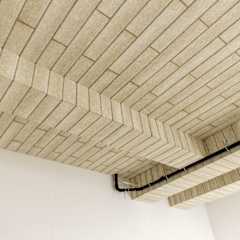
PAROC CGL 20cy is installed in a cellar ceiling.

PAROC CGL 20cy is a non-combustible stone wool insulation lamella for existing and new ceilings in cold or semi-warm spaces such as basements and parking garages. In Tamarinden, the ceiling lamella has been chosen to provide garages with thermal, fire, and sound insulation. With the ceiling lamella, you can easily add thermal insulation to basement ceilings and increase the fire protection between floors. The PAROC CGL 20cy system is ETA approved* for fire protection of concrete structures for up to 4 hours REI 240. For fire protection, 50 mm is practically always enough.  

– There are not many companies in the industry that have a product similar to PAROC CGL 20cy. It is a lamella with a standing structure and beveled edges. These make it hard to see that the roof is slightly uneven. If you have a straight edge, there will be direct shadowing, so here we have found a way to fool the eye, explains Mikael Olofsson. Olofsson goes on to explain how the visible surface of the lamella is primed, shortening the time for any further finishing:

– The installation is done with cement-based adhesive applied directly to the lamella, which is then pressed up against the reinforced concrete floor. The lamellas serve both as energy-saving thermal insulation and effective fire protection, as well as providing good sound absorption. Another advantage is that the lamellas are delivered lying on a pallet with the back side up, so you can apply adhesive to them directly and thus save time.

Site manager Mathias Niia agrees and says that he has used PAROC CGL 20 cy in several other projects before.

I find it incredibly easy and smooth to install PAROC CGL 20 cy. It is a single step, so once you have glued the lamellas, you are done and can move on. In addition, it already has a nice finish and does not need to be painted, Niia says.

– For Tamarinden, I investigated several different products in terms of both price and properties, and PAROC CGL 20 cy was the one that matched best. When working with concrete structures, it is an advantage to have insulation that is forgiving. Then it does not matter if the substrate is a little uneven; the result will still be a nice surface, Niia adds.

Warning: This video contains flashing images that could trigger seizures for people with photo sensitivity.
Share this page: