



From Summer Hire to Maintenance Engineer
A newly graduated chemical engineer steps into a high-tempo maintenance role at a stone wool manufacturing site where safety is treated as a daily discipline, not a slogan. At Owens Corning Paroc, early responsibility, structured onboarding and a team-first culture are key to turning young talent into long-term capability.
When Oskari Tarkkila started at OC Paroc Parainen plant, it was meant to be a summer job. A year later, he is a Maintenance Engineer coordinating daily work, planning longer-term maintenance programs and helping lead people and contractors in a demanding industrial environment.
Tarkkila studied chemical engineering at Åbo Akademi University and graduated this spring. He joined the company the previous May and completed his master’s thesis alongside the job, an applied study on how different parameters affect the performance and adjustment of vibrating stone feeders. “I’m happy with the outcome. I did it alongside work and stayed on the schedule I set for myself,” he says.
The transition from student to full-time engineer was accelerated by the variety of tasks he encountered early on. During the summer he also covered for both the mechanical maintenance supervisor and the electrical supervisor during holidays, giving him a broad view of how maintenance decisions ripple through production, safety and resourcing. “There’s a lot of problem-solving and being in between electrical and mechanical maintenance. Sometimes you have your own projects, and there’s a wide scale of things on your desk,” Tarkkila says.
His role includes daily task prioritization, long-term planning, onboarding of contractors, running safety moments, and handling people-related topics such as shift coverage and holidays. The biggest challenge, he says, is the unexpected: equipment failures that disrupt plans and require calm, fast decisions. But those moments are also where the job becomes most rewarding. “The biggest challenges are unexpected breakdowns. But we’re prepared and we can respond and get the line running again. And it’s really rewarding when you get it fixed,” he says.
For Tarkkila, the steepest learning curve has been mental rather than technical: staying composed while juggling multiple priorities. “It’s been about having many things going on at the same time and staying calm under pressure,” he says.
Safety is top priority
At OC Paroc, that pressure is balanced by a clear hierarchy of values. Safety is not presented as a separate program; it is embedded in daily routines and reinforced continuously. Tarkkila describes safety culture as something that must be actively built because it does not sustain itself. “Safety is always number one, but it doesn’t happen by itself. It takes constant effort,” he says. “We’re never in such a hurry that we would compromise safety. The priority is that everyone goes home in good condition.”
The environment makes that mindset essential. A stone wool plant with over 100 employees combines heavy traffic and lifting operations with hot surfaces and complex equipment, conditions that require constant situational awareness. Tarkkila notes that many of the risks discussed in generic safety training are present simultaneously in this kind of facility, which makes disciplined behavior and clear practices critical.
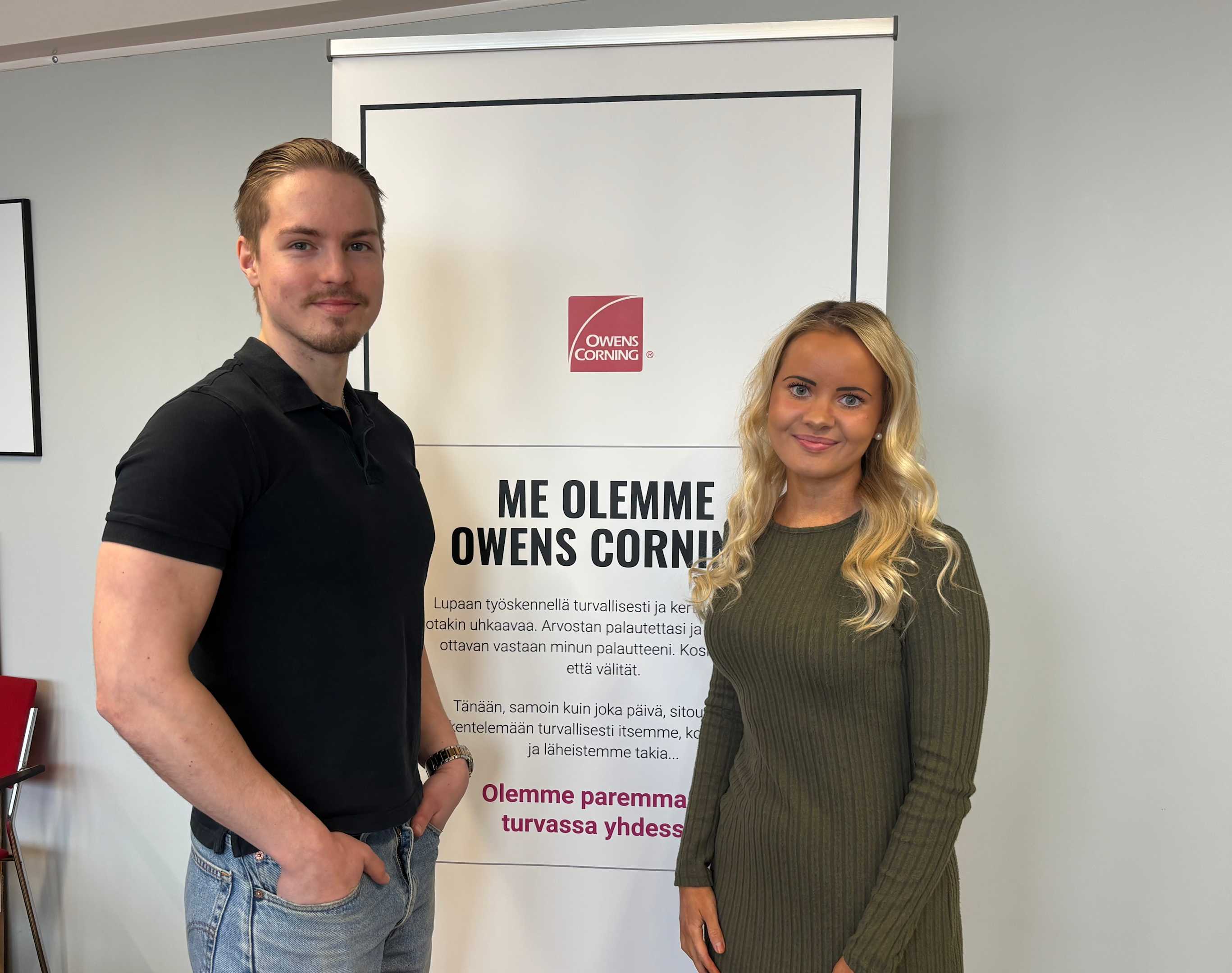
Oskari Tarkkila and Tuovi Helin
Maintenance capability is built through both internal teamwork and selective use of contractors. The site’s mechanical maintenance team includes day-shift mechanics and plant technicians, supported by roles such as storekeeper, an electrical engineer and maintenance leadership. Contractors are used either as extra capacity or for specialized tasks. For a young engineer, this means learning to lead across different groups early, own employees, shift-based roles and external partners.
Because Paroc is part of a larger international Owens Corning group, knowledge sharing extends beyond the site. Tarkkila says collaboration with other factories is frequent, especially when troubleshooting: if a system is not working well in one location, teams reach out to peers elsewhere to learn how they solved similar issues. The exchange is often case-by-case, but it creates a practical network for spreading good practices.
From the HR perspective, onboarding and early development are designed to be local and hands-on while still aligned with broader company principles. HR Generalist Tuovi Helin says new employees are primarily trained locally because the needs of each site are best understood on the ground. “Onboarding happens mainly locally. Safety is the top priority, and we make sure people understand the site and safe ways of working,” Helin says.
Day-to-day mentoring and shadowing
For summer employees, the approach is team-based: a supervisor owns the onboarding, while an experienced colleague acts as a day-to-day mentor. New hires typically shadow for the first weeks and gradually take on tasks independently. Feedback is collected continuously to identify gaps and improve the process. “We gather feedback all the time, from the person being onboarded and from the person doing the onboarding, so we can see what’s working and what needs more support,” Helin says.
Summer recruitment is also a strategic talent pipeline. Helin notes that the Parainen site typically hires over 10 summer employees annually, with one or two roles in maintenance. The company uses its own career channels, LinkedIn and university recruitment events to reach candidates. In her experience, interest has been strong. “We’ve had a good number of applicants, and we’ve been able to reach the target groups we want,” Helin says.
In an industry where reliability and safety are inseparable, the story of a young engineer moving quickly from summer hire to a key coordination role highlights a broader point: maintenance organizations can attract and retain new talent when they offer meaningful responsibility, structured onboarding and a culture that treats safety as a shared daily practice not just a compliance requirement.
Related Articles

From Summer Hire to Maintenance Engineer

Decades of in-house knowledge drive the Reinvention of Hällekis